

THE ART GALLERY 2
This Page Shows Our Photographs That Capture and Identify Canada’s Wild Identity
05
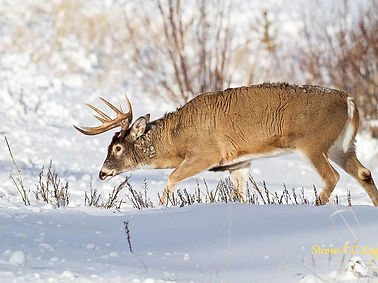
White tail deer
The white‑tailed deer is easily recognized by its white “flag” tail, reddish‑brown summer coat, and upward‑growing antlers. Found throughout Alberta’s forests and river valleys, this deer feeds on leaves, twigs, berries, fruits, forbs, and shifts to woody browse and lichens during the winter months. Its raised tail and quick bounding escape make it one of Canada’s most iconic and identifiable wildlife species.
06
Black bear
Black Bear — Alberta
The American black bear (Ursus americanus) is Alberta’s most common bear, found across the province except the far southeast.
Appearance
Black bears range in colour from black to cinnamon, chocolate, or blond, all with a brown muzzle and sometimes a white chest patch. Adult males reach 170 kg and 1.5 m, with females about two‑thirds that size. They have a stocky build, rounded ears, and curved claws for climbing. They move with a heavy gait but can run 45 km/h and swim well.
Behavior
Mostly nocturnal, though active anytime. Females give birth every 2–3 years, usually 1–5 cubs (most often 2), born in January–February in the den. During winter dormancy, their metabolism drops to 25% and heart rate can fall to 9 bpm.
Habitat in Alberta
They prefer undisturbed forest, commonly seen in valley bottoms, forest edges, and areas with abundant vegetation in Alberta’s mountain parks.

Diet
Black bears are omnivores, but mostly plant‑eaters. They eat sprouts, buds, flowers, fruits, and nuts, plus carrion, small mammals, fish, and insects when available. In wilderness areas, about 95% of their diet is vegetation, with 5% coming from insects and small animals. They may also eat human food, garbage, grain crops, and occasionally livestock if accessible.
07
Grizzly bear
Grizzly Bear — Alberta Identification
The grizzly bear (Ursus arctos) is one of Alberta’s most powerful and iconic wildlife species, found mainly in the Rocky Mountains, foothills, and northern wilderness.
Appearance
-
Colour: Usually brown, but can range from blond to dark chocolate. The signature feature is the silver‑tipped “grizzled” fur on the back and shoulders.
-
Size: Adult males often weigh 200–350 kg, with large individuals exceeding 400 kg. Females are smaller, usually 100–200 kg.
-
Build: Massive shoulders with a distinct muscular hump, long curved claws (up to 10 cm) for digging, and a broad, concave facial profile.
-
Claws: Light‑coloured, long, and clearly visible — unlike the shorter, darker claws of black bears.
Behavior
-
Activity: Mostly active during the day but can be active anytime.
-
Movement: Despite their size, grizzlies can run up to 55 km/h.
-
Reproduction: Females give birth every 3–4 years, usually 1–3 cubs, born in winter dens.
-
Temperament: More defensive and territorial than black bears, especially around cubs or food sources.
Habitat in Alberta
Grizzlies prefer mountain valleys, alpine meadows, river basins, and dense forest edges. They are most common in Banff, Jasper, Kananaskis, Waterton, and the northern boreal regions.
_edited.jpg)
Behavior
-
Activity: Mostly active during the day but can be active anytime.
-
Movement: Despite their size, grizzlies can run up to 55 km/h.
-
Reproduction: Females give birth every 3–4 years, usually 1–3 cubs, born in winter dens.
-
Temperament: More defensive and territorial than black bears, especially around cubs or food sources.
Habitat in Alberta
Grizzlies prefer mountain valleys, alpine meadows, river basins, and dense forest edges. They are most common in Banff, Jasper, Kananaskis, Waterton, and the northern boreal regions.
Diet
Grizzly bears are omnivores, with a diet that varies by season:
-
Roots, grasses, berries, nuts, and plants
-
Insects, especially ants
-
Fish, including spawning salmon where available
-
Carrion and large mammals (elk, deer, moose calves) when the opportunity arises
-
They are powerful diggers and often feed on ground squirrels and other burrowing animals
Grizzlies rely heavily on high‑calorie foods in late summer and fall to build fat reserves for winter denning.
04
mule deer
Mule Deer — Alberta Identification
The mule deer (Odocoileus hemionus) is one of Alberta’s most recognizable wildlife species, named for its large, mule‑like ears and distinctive bounding gait.
Appearance
-
Ears: Very large, wide, and mule‑like, often the easiest way to identify the species.
-
Colour: Grey‑brown in winter and tan‑brown in summer, with a white rump patch.
-
Tail: Short, thin, and black‑tipped — unlike the white‑tailed deer’s “flag” tail.
-
Face: Dark forehead with a lighter muzzle and eye region.
-
Antlers (bucks): Antlers fork, splitting into two main branches that fork again — the classic mule deer antler pattern.
Behavior
-
Movement: Known for its stotting or bounding gait, where all four legs land together.
-
Activity: Most active at dawn and dusk.
-
Temperament: Generally calm but alert; often pauses to look back before moving.
Habitat in Alberta
Mule deer prefer open terrain, including:
-
Foothills
-
Prairie grasslands
-
Badlands
-
Shrublands and coulees
They are common in southern and central Alberta, especially in areas with mixed forest and open feeding grounds.

Diet
Mule deer are browsers, feeding mainly on:
-
Shrubs, twigs, buds, and leaves
-
Sagebrush, willow, aspen shoots
-
Forbs and grasses in summer
-
Agricultural crops when available
Their diet shifts seasonally, relying more on woody browse during Alberta’s winter months.

